Ask people over 50 whether they exercise and many will mention walking, gardening, or swimming. Ask whether they do anything to keep their muscles strong and the answer is often a pause. Strength training carries an image, usually a gym, a young person, and a great deal of grunting, that puts many adults off before they start.
That image is a shame, because the guidelines are clear, and the habit itself is far more ordinary than the image suggests.
What the research suggests
The Physical Activity Guidelines for Americans, published by the U.S. Department of Health and Human Services, recommend that adults do muscle-strengthening activities of moderate or greater intensity, involving all major muscle groups, on two or more days a week. That recommendation applies to older adults as well, with the addition of balance training. The CDC carries the same guidance.
The reason is straightforward. Muscle mass and strength tend to decline with age, a process that begins in midlife and accelerates later if nothing is done about it. The National Institute on Aging notes that strength is what allows people to carry groceries, climb stairs, get up from a chair, and recover from a stumble. Losing it is one of the main ways independence erodes, and research suggests that regular strength training may help older adults maintain muscle and function, even when they start late.
The encouraging part of the research is that the response to strength training does not appear to switch off with age. Adults who begin in their sixties and seventies can and do get stronger. The gains may come more slowly than they would for a younger person, but they come.
What strength training actually is
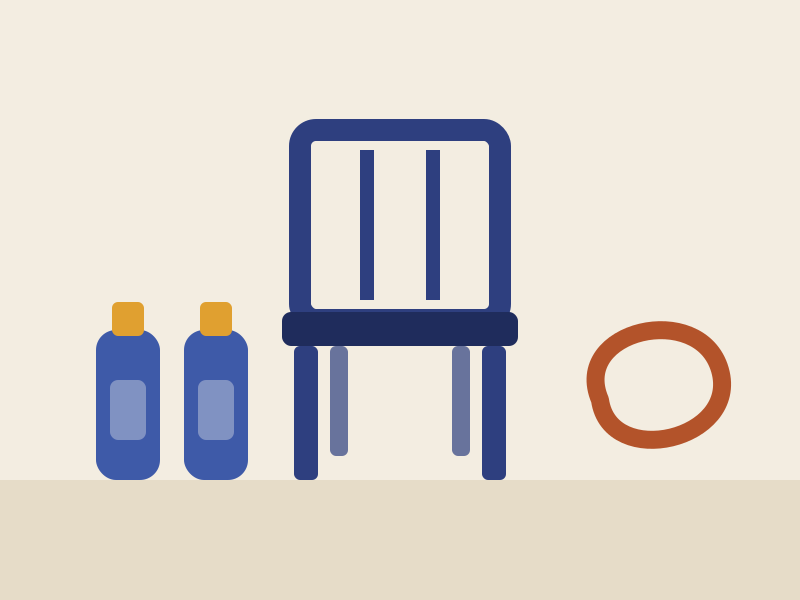
Strength training means asking a muscle to work against resistance hard enough that it adapts. The resistance can be a barbell, but it can also be your own body weight, a filled water bottle, a bag of flour, a resistance band, or the back of a kitchen chair for support.
The movements that matter most are the ones that mirror daily life: standing up from a seated position, pushing something away, pulling something toward you, lifting something from the floor, and carrying a load. A short routine that covers those patterns twice a week meets the guideline and covers the major muscle groups.
The intensity that counts is "moderate or greater." In practice that means the last few repetitions of a set should feel like effort. If you can do twenty easily, the movement has become too easy and it is time to add a little resistance or a harder version.
How to start small
Begin with a chair. The single most useful strength movement for older adults is the sit-to-stand: sitting at the front of a sturdy chair and standing up without using your hands, then sitting back down under control. Do as many as you can with good form, rest, and repeat once. That is a starting routine on its own.
Add one push and one pull. A push can be a wall push-up, standing an arm's length from a wall and pressing away from it. A pull can be a row using a resistance band anchored to a door handle, or lifting a light weight from a bent-over position. Eight to twelve repetitions, one or two sets.
Add a carry. Pick up something with a bit of weight in each hand, a pair of filled water bottles works well, and walk across the room and back with good posture. This trains grip, shoulders, and trunk at the same time.
Keep the first month easy. The most common reason people quit strength training is soreness in the first two weeks. Start with fewer repetitions than you think you can do, and increase slowly. Being slightly under-worked at the start is a good trade for still doing it in month three.
How to keep it
- Name the days. Tuesday and Friday, or whichever two days are least likely to be disrupted. "Twice a week" without named days tends to become once a week, then none.
- Keep it short. Fifteen to twenty minutes is enough for a routine of four or five movements. Long sessions are harder to fit and easier to skip.
- Write it down. A small notebook with the date, the movements, and the repetitions. Watching the numbers creep up over months is one of the most motivating things about strength work.
- Progress slowly. When a movement becomes easy, add a couple of repetitions or a little weight, not both, and not every session.
- Pair it with something. Many people find strength work easiest to keep when it happens right before or after another fixed habit, such as a morning walk or a favorite program.
Common questions
Do I need a gym? No. A gym offers more options and can be motivating, but a chair, a wall, and a few household objects are enough to meet the guideline. Many people add a set of resistance bands later, which are inexpensive and store in a drawer.
What about my joints? Well-designed strength work often feels good for stiff or achy joints, because stronger muscles support them better. Pain during a movement is a signal to change the movement, reduce the range, or ask for guidance, not to push through.
Is walking enough? Walking is excellent and meets the aerobic part of the guidelines. It does not meet the strength part. The two are complementary.
How long before I notice a difference? Many people notice that stairs and chairs feel easier within the first couple of months, often before any visible change. Strength gains in the nervous system tend to come before changes in muscle size, which is why the notebook matters: it shows progress that the mirror does not.
When to talk to a clinician
Most adults can begin gentle strength work safely, but check with a healthcare professional first if you have a heart condition, uncontrolled high blood pressure, osteoporosis, a recent surgery or injury, joint replacements, or any condition that affects balance. A physical therapist can design a starting routine around specific limitations. Stop and seek advice if you experience chest pain, dizziness, or sharp joint pain during exercise. This article is general information, not personal medical advice.